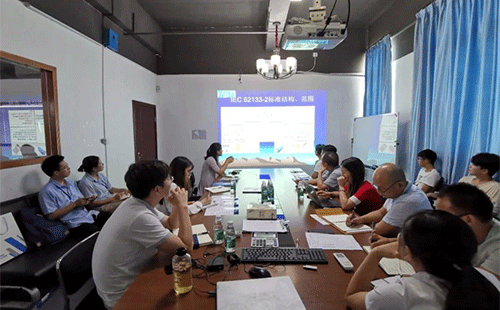
With the frequent accidents of thermal runaway of lithium-ion batteries, nickel-based batteries have always occupied an important position in remote control, electric toys, portable electronic equipment and other fields because of their high safety and strong abuse tolerance. Recently, the International Electrotechnical Commission (IEC) officially released the new standard IEC 62133?1:2026 for the safety of nickel-based portable batteries. This is the first major update of the standard in 9 years, which will directly affect the global battery access and export compliance.
Standard Quick View: Who will be affected?
Full name of the standard: Secondary batteries and storage batteries containing alkaline or other non-acidic electrolytes-Safety requirements for portable sealed secondary batteries and assembled batteries-Part 1: Nickel batteries.
Release date: March 2026 (IEC)
Alternative version: IEC 62133?1:2017
Applicable products: portable sealed secondary nickel battery containing alkaline electrolyte and its assembled batteries, including Ni-MH battery, Ni-Cd battery, etc.
Coverage scenario: Full scenario safety verification of batteries and battery packs in normal use, transportation, storage and foreseeable misuse.
Core changes of the new standard IEC 62133?1:2026
1. Redundancy definition is deleted, and the standard is more streamlined and efficient
The new version of the standard directly deletes the three basic definitions of "secondary battery", "portable battery" and "portable battery unit", and no longer spends space to explain the general terms in the industry, but instead focuses entirely on the safety requirements and testing methods of the products themselves, making the standard text more concise and efficient to implement.
2, the temperature condition is clear, and the test is more comparable
In clause 7.2.3 of the standard, the original vague expression "room temperature" is explicitly replaced by “20°C ± 5°C”.
This is one of the key changes in this revision, which effectively solves the problem of great differences in testing environment between different laboratories and different seasons in the past, so that the test results around the world can be directly benchmarked, and at the same time, higher requirements are put forward for the environmental control of laboratories, which indirectly enhances the authority of test results.
3, the test criterion is visualized, and the monitoring is more clear and traceable
The test temperature chart is optimized in clause 7.2.4 of the standard, which makes the temperature monitoring nodes in the process of charging and discharging more clear and traceable, avoids the interpretation deviation caused by fuzzy criteria in the previous test process, and also makes the supervision department's audit of the test process more targeted.
Core test item (battery+battery pack)
Although the new standard has been optimized, the core safety test items of nickel-based batteries remain stable, mainly including:
Battery level test:
◆ Continuous low-rate charging
◆ Vibration test
◆ Temperature cycle
◆ External short circuit
◆ Drop test
◆ Impact (collision) test
◆ Thermal misuse (thermal shock)
◆ Extrusion test
◆ Low pressure test
◆ Overcharge test
◆ Forced discharge
◆ Incorrect installation (unique to nickel series)
◆ Marking and packaging inspection
Battery pack level test
◆ Vibration test
◆ Shell stress at high temperature
◆ Temperature cycle
◆ External short circuit
◆ Drop test
◆ Impact (collision) test
◆ Marking and packaging
◆ Overcharge (unique to nickel system)
Influence of new standard on enterprises
1. Export threshold has been raised: the EU has adopted the new version of the standard at the same time, and products that fail to meet the standard will not be able to enter the EU market, and North America, Asia-Pacific and other regions will gradually follow suit. During the version switching period, it is necessary to focus on the adoption schedule of the target market, so as to avoid the risks of product customs clearance obstruction and market recall caused by not adapting to the new version of the standard in time.
2. Fine-tuning of test cost: The clarification of temperature conditions requires the laboratory to improve the accuracy of environmental control, and the test cost may increase slightly, but the comparability and authority of test results also increase simultaneously. In the long run, it can help enterprises reduce the cost of repeated certification and rework caused by inconsistent test results.
3. Natural transition of certificates: The validity period of IEC 62133-1 certification certificate is usually 3 years. The certificate of 2017 edition held by enterprises will naturally transition to the certificate of 2026 edition when it expires. It is not necessary to replace it in advance, but it is necessary to adapt the products in advance during the validity period of the certificate to ensure that the products can meet the requirements of the new version of standards when replacing the certificate and avoid being blocked in replacing the certificate.
Corporate compliance advice
1. Benchmark the old and new standards and accurately identify the differences: organize a technical team to compare the terms of the old and new standards as soon as possible, focus on the core change points such as temperature conditions, terminology definitions and test charts, clarify the expected differences of product certification in combination with the characteristics of the company's own products, sort out the shortcomings of compliance, and avoid compliance mistakes caused by misunderstanding.
2. Optimize product design and improve safety performance: According to the environmental adaptability requirements of the new standard (such as clear temperature conditions), optimize product design and select compliant raw materials to improve the safety performance of batteries in harsh environment, meet compliance requirements from the source and reduce the cost of later rectification.
3. Adjust the certification plan to avoid listing risks: adjust the product testing and certification plan in advance, evaluate whether the existing products and production lines meet the requirements of the new version, and re-submit them for inspection in time if necessary to obtain the new version of the test report; At the same time, pay attention to the adoption progress of standards in various export regions, plan the time to market reasonably, and avoid listing delay and order loss caused by compliance problems.
Warm tips
The release of IEC 62133-1:2026 indicates that the international safety threshold of nickel-based batteries is further tightened, and it is also an inevitable trend for the industry to develop towards "safer and more standardized". These seemingly "streamlined" revisions, such as deleting redundant definitions, clarifying test conditions and optimizing test criteria, actually make the standards focus more on the nature of safety and put forward higher requirements for the compliance ability of enterprises. ZRLK suggested that relevant enterprises should meet the requirements of IEC 62133?1:2026 in advance, standardize product safety design and testing procedures, avoid market access risks and ensure products to be listed in compliance. Our company has a professional technical team and rich experience in product testing, which can help enterprises enter the target market in compliance with regulations. If you need it, please feel free to contact us, and our engineers will serve you at the first time!