Center Certification & Testing International

Introduction to Hearing Aid Compatibility Testing
Hearing aid users always complain that when someone nearby calls the hearing aid, they often hear a "click" noise, which indicates that the phone and hearing aid may not be compatible. According to this situation, in September 2006, the US FCC enforced the HAC (Hearing Aid Compatibility) certification program for mobile phone manufacturers. Its HAC reference standard is ANSI C63.19 (US wireless communication equipment and hearing aid compatibility measurement country Standard method). According to the standard definition, consumers can judge the compatibility of a certain type of hearing aid and mobile phone by the anti-interference level of the hearing aid and the corresponding mobile phone signal transmission level.
The HAC test plan requires that the limit of the mobile phone under test is M3 (the test results are divided into M1~M4). The specific definition of the limit will be explained later in the text. In addition to HAC, T-coil (audio test) must also require the limit to be within the range of T3 (the test results are divided into T1~T4).
The HAC test system of ZRLK Lab (STS LAB) can complete its RF test and electromagnetic band electromagnetic signal requirements according to HAC standards. The test range includes two parts: wireless communication equipment (WD) and hearing aids (HA). The test frequency It is a communication product between 800~950MHz and 1.6~2GHz. Cordless phones, mobile point phones, personal communication services (PCS), etc. at this frequency can all be HAC certified.
Simple test process for electric and magnetic fields (wireless communication equipment near-field radiation test process):
Make sure that the probe and test instrument work properly
WD configuration WD works in launch state

Initialize the field strength probe for area scanning

Identify excluded areas, set up isolation and rescan other areas, and record the largest reading electric field and magnetic field to complete the scan

Confirmation and record classification

If necessary, rescan the electric and magnetic fields
The main measuring instruments used are
1. Near-field electric field probe;
2. Near-field magnetic field probe;
3. Warhead positioning device;
4. Support system for wireless communication equipment (WD);
5. Auxiliary equipment such as radio frequency shielding room;
In the near-field test, the near-field probe uses the electric field probe or the magnetic field probe to scan the maximum field strength of the measurement area in the 5cm*5cm area. In multiple pulse periods, by measuring the peak value, the average field strength of the measured object can be obtained based on the measured average value and the calculation of the known wireless communication device duty cycle. The distance between the nearest point of the probe and the reference plane of the wireless communication device must be 1.0 cm.
The wireless communication equipment must perform the following steps before performing near-field radiation testing
1. In the modulation mode of the wireless communication device, calibrate the peak readings of the electric field and magnetic field probes;
2. Check and confirm the repeatability and accuracy of the probe positioning system;
3. Confirm that the reflected interference of the measured object is more than 20dB lower than the expected signal. This can be achieved by repeatedly measuring the same wireless communication device in multiple positions and directions. The difference in reading caused by reflection must not be greater than ±0.8dB; after confirming that the probe and test instrument are working normally and the wireless communication device is in the transmission mode, the field strength probe can be initialized and area scanned, and the system will automatically Record the maximum reading (V/m or A/m) and the results will be sorted according to the table below.
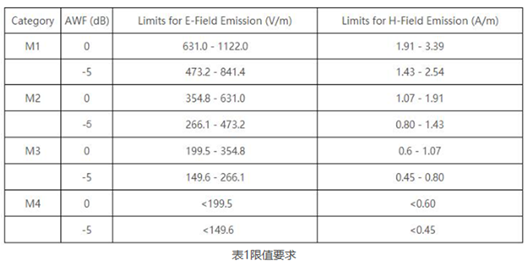
HAC (hearing aid compatibility) wireless communication equipment's electric field and magnetic field tests are briefly introduced. In this issue, the HAC test of wireless devices' magnetic field strength measurement (T-coil) requirements in the audio band will be briefly introduced.
The HAC test is based on the standard ANSI-C63-19 and the national standard is YD/T 1643-2007. In the measurement of the magnetic field strength of wireless communication devices in the audio band, we need to test and evaluate three values. The first value is the magnetic field density of the intentional signal (system signal) at the center frequency of the audio frequency band. The second The value is the frequency response of the intentional signal in the entire audio frequency band, and the third value is the difference between the magnetic field strength of the intentional signal (system signal) and the unintentional signal (interference signal).
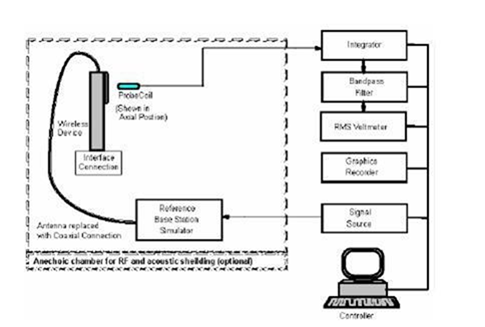
Figure 1T-COL magnetic field test setu
T-Coi test and measurement instruments include the following equipment
1. Base station simulator/RF communication tester supporting audio input or output
2. Probe coil assembly
3. True RMS voltmeter
4.1/3 octave band-pass filter
5. Power supply
6. Helmholtz calibration coil
The HAC detection method is: controlling the wireless communication device to be in a call mode, and requiring the base station simulator to provide a simulated audio signal to the wireless communication device. The base station simulator controls the wireless communication device to be in the state of maximum transmission power. This is mainly due to the fact that in the maximum power mode, the accurate calculation of its baseband part may have an effect on the coil in the earpiece. It should be noted that when measuring, you need to use RF cables to connect instead of wireless methods. This is mainly to shield the radio frequency transmission signal from the measurement process.
The entire test process is completed by the following multi-level procedure, first measuring the magnetic field strength of the audio frequency band useful for the hearing aid T-coil. The second step measures the unintended signal magnetic field component to determine the impact of the wireless communication device display and battery current path on the audio frequency band intentional signal. The following is the general flow of the measurement (micro-signal test process for wireless communication equipment sound engineer division):
1. Determine the calibration of the measuring instrument
2. Set and verify the test configuration to determine the reference value

Measuring intentional audio frequency band signals
Measuring unintentional audio frequency band signals

1. Signal quality
2. Magnetic field strength
3. Frequency response

Identify and record classification information
The purpose of HAC certification is to avoid the influence of the electromagnetic field formed by the digital mobile phone around the antenna on hearing aids used by people with disabilities. The HAC testing laboratory of the ZRLK testing center is a domestic laboratory that provides third-party HAC testing certification, which fully meets the American standard ANSI-C63-
19 and the national standard YD/T 1643-2007 test requirements, and has completed a large number of HAC testing and pre-research work for domestic mobile phone companies, ensuring that its communication products meet the protection requirements of disabled people in various countries.


Australian RCM certification
Label printers entering the Brazilian market, ANATEL certification is an essential passport! It is the recognition of the Brazilian Telecommunications Authority for the safety and compliance of electronic products, without which products cannot be legally sold.

SRRC certification is not only a guarantee of product compliance, but also a key to opening up the market.
Hearing aid users always complain that when someone nearby calls the hearing aid, they often hear a \"click\" noise, which indicates that the phone and hearing aid may not be compatible. According to this situation, in September 2006, the US FCC enforced the HAC (Hearing Aid Compatibility) certification program for mobile phone manufacturers.
Get a quote

Tik Tok