Introduction to UN38.8:
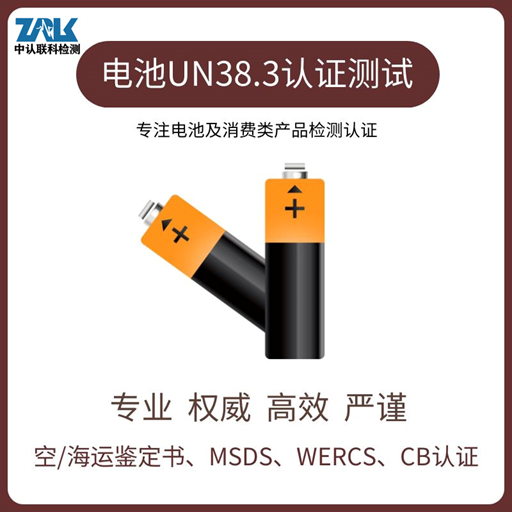
In order to ensure the safety of air transportation and meet the customer's transportation needs of lithium-containing battery cargoes, according to the relevant provisions of the International Air Transport Association's "Dangerous Goods Regulations", a rechargeable lithium battery operation specification, UN38.3 test, was developed.
According to the requirements of civil aviation regulations, airlines and airport cargo collection and transportation departments should review the transport documents of lithium batteries. The most important thing is the UN38.3 safety test report of each type of lithium battery. The report can be provided by a third-party testing agency designated by civil aviation, or by a battery manufacturer with testing capabilities. If this test report cannot be provided, civil aviation will prohibit lithium batteries for air transportation.
Specific requirements:
UN38.3 refers to section 38.3 of Part 3 of the "United Nations Manual of Hazardous Materials Transport Tests and Standards" specially formulated by the United Nations for the transportation of dangerous goods. That is, before the lithium battery is transported, it must pass a high degree of simulation, high and low temperature cycles, Vibration test, impact test, 55℃ external short circuit, impact test, overcharge test, and forced discharge test can ensure the safety of lithium battery transportation. If the lithium battery and the device are not installed together, and each package contains more than 24 battery cells or 12 batteries, it must also pass the 1.2-meter free drop test.
Product Range:
1. Various lead-acid batteries (such as lead-acid batteries for car startup, stationary lead-acid batteries, small valve-regulated sealed lead-acid batteries, etc.)
2. Various power secondary batteries (such as batteries for power vehicles, batteries for electric road vehicles, batteries for power tools, batteries for hybrid vehicles, etc.)
3. Various mobile phone batteries (such as lithium ion batteries, lithium polymer batteries, nickel metal hydride batteries, etc.)
4. Various small secondary batteries (such as laptop batteries, digital camera batteries, video camera batteries, various cylindrical batteries, wireless communication batteries, portable DVD batteries, CD and MP3 player batteries, etc.)
5. Various primary batteries (such as alkaline zinc manganese batteries, lithium manganese batteries, etc.)
standard test:
UN38.3 test items and judgment test pass standards
UN38.3 test items
T.1 Altitude simulation test
Under the condition of pressure ≤11.6kPa and temperature 20±5℃, it can be stored for more than 6 hours without leakage, exhaust, disintegration, cracking and burning.
T.2 Thermal test
The high and low temperature impact test is carried out under the conditions of 72±2℃ and -40±2℃, and the storage time is ≥6h in the limit temperature, the high and low temperature conversion time is ≤30min, the impact is 10 times, and the room temperature (20±5℃) is stored for 24h. The total test time is at least one week
T.3 Vibration test
Complete a reciprocating logarithmic sweep frequency sinusoidal vibration from 7Hz to 200Hz within 15min, and complete 12 vibrations in three dimensions in 3h;
The logarithmic sweep frequency is: from 7 Hz to maintain the maximum acceleration of 1gn until the frequency reaches 18 Hz. Then keep the amplitude at 0.8 mm
(Total offset 1.6 mm) and increase the frequency until the maximum acceleration reaches 8gn (frequency is about 50 Hz). Maintain the maximum acceleration at 8gn until the frequency increases to 200 Hz.
T.4 Impact test
150g, 6ms or 50g, 11ms half-sine shock, 3 times for each installation direction, a total of 18 times;
T.5 External short circuit test
Short circuit under the condition of 55±2℃ and external resistance<0.1Ω, the short-circuit time lasts until the battery temperature returns to 55±2℃ 1h.
T.6 crash test
A 9.1kg weight was dropped from a height of 61±2.5cm on a battery with a 15.8mm round bar, and the surface temperature of the battery was detected.
T.7 Overcharge test
Under the condition of 2 times the maximum continuous charging current and 2 times the maximum charging voltage, overcharge the battery for 24h.
T.8 Forced discharge test
The battery is connected in series with a 12V DC power supply to perform forced discharge with the maximum discharge current.
Judgment test pass standard:
(A) In tests T.1 to T.6, no disintegration or fire occurred.
(B) In tests T.1, T.2 and T.5, the effluent is not toxic, flammable or corrosive.
1> Visual observation does not see exhaust or leakage.
2> No exhaust or leakage that caused the weight loss to exceed those shown in Table 38.3.4.7.1.
(C) In tests T.3 and T.6, the effluent is not toxic or corrosive.
1> Visual observation does not see exhaust or leakage.
2> No exhaust or leakage that caused the weight loss to exceed those shown in Table 38.3.4.7.1.
Packaging requirements and conditions
If you want to know more about the UN38.3 certification test of the battery, you can contact our company and a professional engineer will answer it online for you. ZRLK has been focusing on the testing and certification of batteries and peripheral consumer products for 15 years, always paying attention to the changes of laws and regulations in various countries, and providing customers with one-stop certification services in multiple countries and regions to ensure that your products quickly enter the target market.